
This is Post 10 of 16 in the Taiwan Risk Series. Full series at polarismng.com
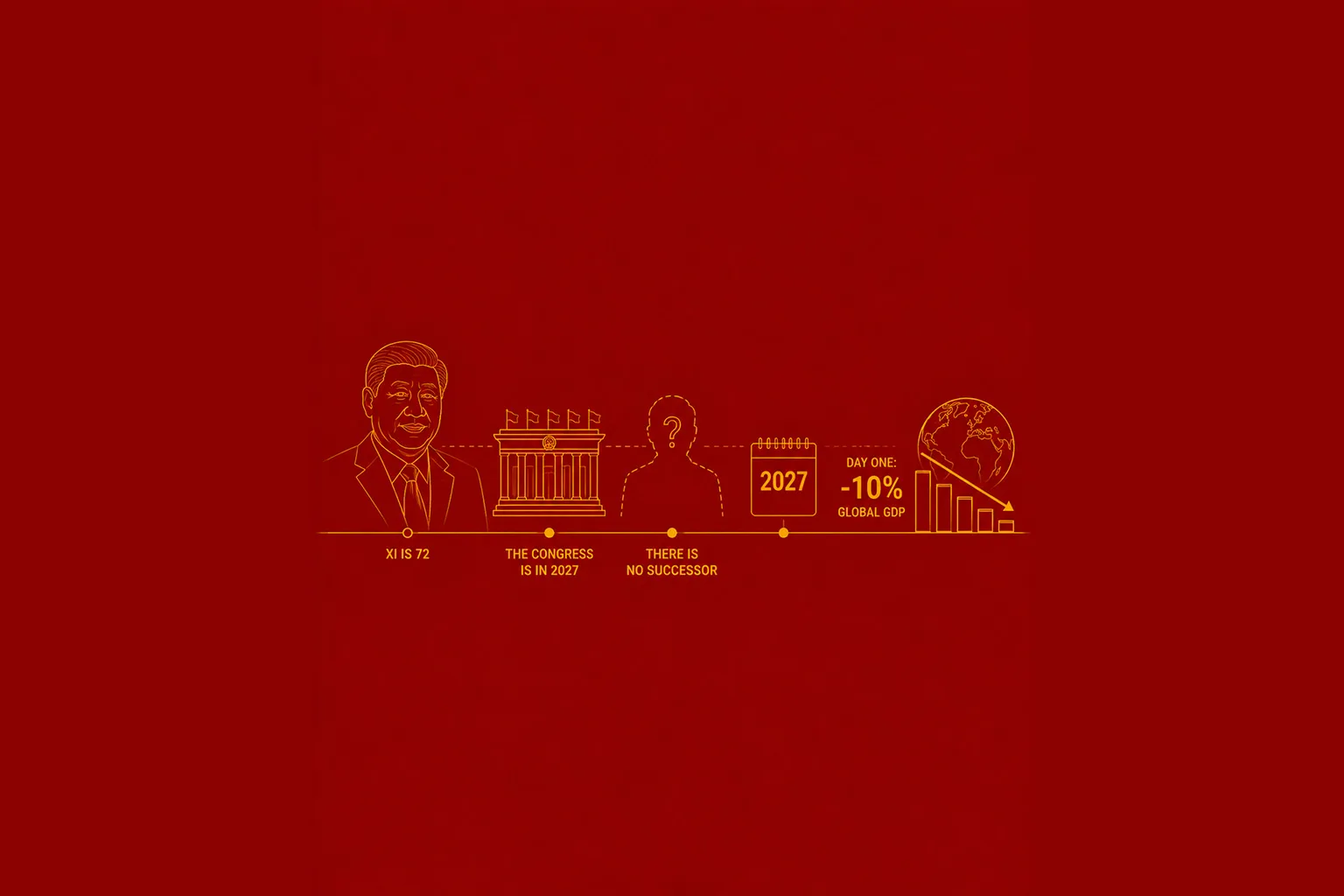
KPI #10 — Xi Is 72, the Congress Is in 2027, and There Is No Successor
The Political Clock
What it measures: Proximity to the 21st CCP National Congress (late 2027), Xi Jinping’s succession horizon, and the degree to which his personal legacy calculus overrides institutional risk assessments.
Every other KPI in this dashboard is a military or economic variable. This one is political — and it is the one that can override all the others.
Xi Jinping is 72 years old. He has tied his historical legacy to “national rejuvenation” — a term the CCP defines explicitly as including Taiwan. At the 20th Party Congress in 2022, he abolished the term limits that had governed Chinese leadership since the 1990s and secured an unprecedented third term. The 21st Congress, expected in late 2027, will ratify his fourth term. There is no announced successor. There is no credible succession process visible to outside observers.
A leader who has removed institutional constraints on his power, who has no successor, and who has publicly defined his historical legacy in terms of a territorial objective that remains unachieved — that leader faces a political clock that no military assessment can fully override. If Xi concludes that the 2027 Congress is the last moment to act before China’s demographic and economic trajectory shifts the balance of power, the political calculation overrules the military readiness calculation.
Current status: 🟡 Amber. The 21st Congress is approximately 18 months away. No credible successor has been identified. The political clock is ticking.
And If the Clock Runs Out: Consequence #1
A -10% Global GDP Shock With No Historical Precedent
This is where the KPI dashboard connects to what it is actually measuring: the probability of a scenario that Bloomberg Economics models as the largest single economic shock in modern history.
In the full-conflict scenario — a Chinese invasion drawing US military intervention — Bloomberg Economics estimates a -9.6% contraction in global GDP in year one. To contextualise that number: the 2008 financial crisis contracted global GDP by approximately 2%. COVID-19 contracted it by approximately 3.5%. The Taiwan scenario eclipses both — combined — in a single year.
🟡 Naval blockade only → Global GDP: -5.0%
🟡 Invasion without US involvement → Global GDP: -7.0%
🔴 Invasion with US-China conflict → Global GDP: -9.6% to -10.2%
The three channels driving this number: semiconductor supply chain disruption (the dominant factor), trade shocks from shipping route closure and sanctions, and financial market contagion.
📍 Next in the series
Consequence #2 — China Wins the Island and Loses 16.7% of Its Economy. Why invasion is economically irrational by conventional measures — and why that may not be enough to prevent it.
⚡ The consequence to watch
A -10% global GDP shock is not a recession. It is a depression. The last time global GDP contracted at that rate was the Great Depression of the 1930s. If your business continuity plan was written for a “severe recession” scenario, it was not written for this.
🔧 The drill
Run a stress test: what does your business look like if global revenues contract by 10% simultaneously, semiconductor lead times extend to 24 months, and shipping costs triple — all at once, sustained for 18 months? If you have not modelled that scenario, you are managing geopolitical risk reactively.
Sources: Bloomberg Economics (Feb 2026); China Leadership Monitor (Nov 2025); The Diplomat (Aug 2025); ODNI (March 2026). Full series: polarismng.com