
This is Post 14 of 16 in the Taiwan Risk Series. Full series at polarismng.com
Consequence #5+6 — $14 Trillion at Risk, and That’s Before You Count South Korea and Japan
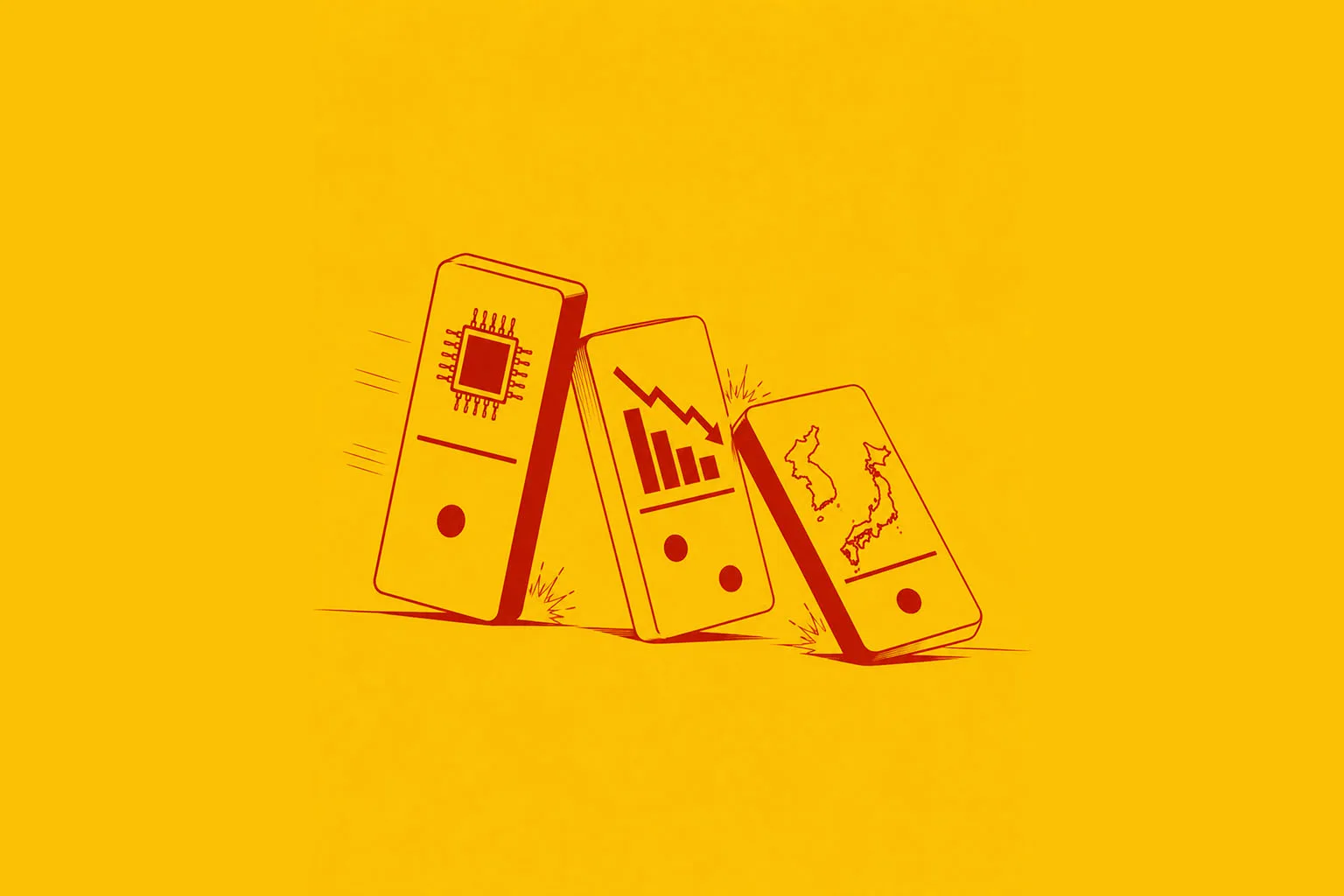
The Taiwan risk is often framed as a US-China bilateral problem. It is not. It is a global supply chain problem with a particularly acute concentration of pain in East Asia.
The $14 Trillion Equity Exposure
TSMC’s ten largest customers — Nvidia, Apple, AMD, Qualcomm, Broadcom, and others — have a combined market capitalisation approaching $14 trillion. These are not just technology companies. They are the primary drivers of equity market returns in the United States, Europe, and Japan over the past decade. They are inside pension funds, index funds, sovereign wealth funds, and retail investment portfolios on every continent.
A supply chain severing of this magnitude would not create a sector correction. It would create a systemic equity market shock. The repricing would happen before any military outcome was clear — within days of a confirmed conflict beginning, as markets priced in the semiconductor supply scenario.
South Korea and Japan: The Countries Nobody Mentions
South Korea and Japan are not parties to any US-Taiwan defence arrangement. They are, however, the two economies most severely impacted after the direct protagonists in every conflict scenario model.
South Korea hosts Samsung and SK Hynix — the world’s dominant memory chip producers. A Taiwan conflict disrupts their export markets, activates regional military contingencies, and creates immediate security exposure given proximity. Japan’s machinery and precision equipment exports — which flow heavily into the same technology supply chains — face simultaneous collapse.
Both countries also host US military installations. Their involvement in any conflict scenario is not optional.
🔴 TSMC top-10 client market cap: ~$14 trillion
🔴 South Korea + Japan combined GDP exposure: among highest in the world per Bloomberg scenario models
🔴 Samsung + SK Hynix: primary memory chip suppliers — immediate export market collapse
📍 Next in the series
Consequence #7 — The Taiwan Strait Carries $5 Trillion a Year. What Happens When It Closes? The shipping dimension — and why the Red Sea crisis of 2024 was a small-scale preview of something much larger.
⚡ The consequence to watch
If you hold index funds with significant technology weighting — which describes the majority of defined-contribution pension schemes globally — you have Taiwan exposure in your retirement savings. This is not a geopolitical abstraction. It is a personal financial planning variable.
🔧 The drill
Check your investment portfolio’s technology sector weighting. Identify which holdings have material TSMC customer concentration. Consider whether your risk allocation reflects a world where that concentration remains intact indefinitely — or whether some diversification away from single-node chip dependency makes sense at the portfolio level.
Sources: Bloomberg Economics (Feb 2026); AEI (2024); Insurance Journal (2024). Full series: polarismng.com